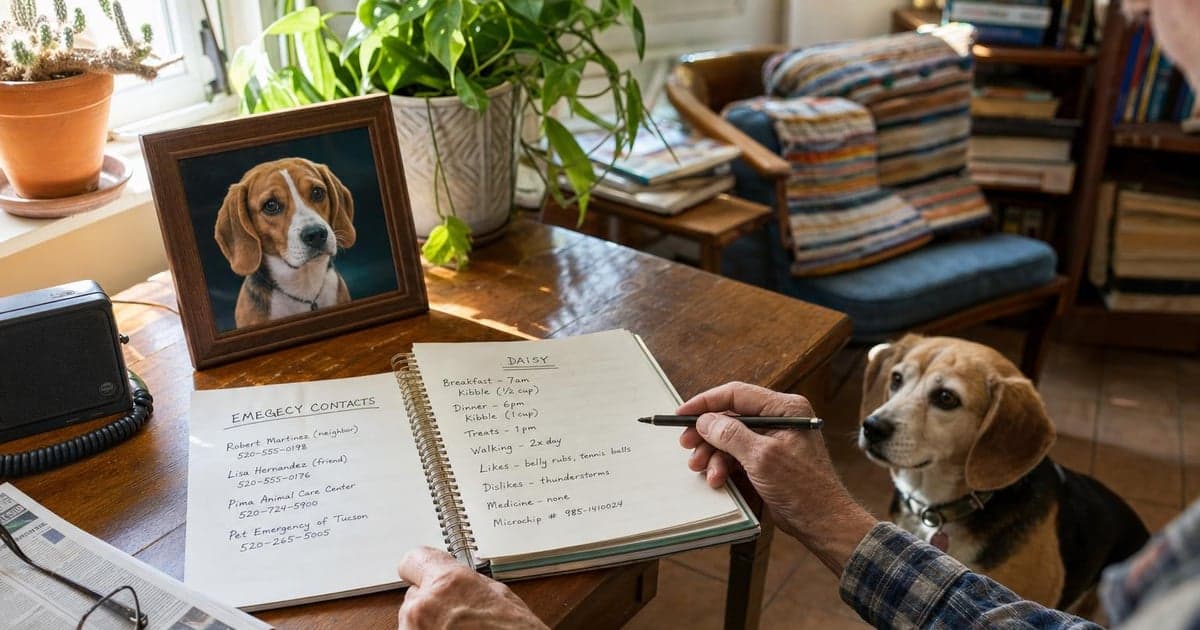
If something happened to you today, who would take your dog? Not eventually, not after paperwork sorted itself out, but within hours? Most people who live alone with a dog have turned this question over in their heads at least once. Very few have answered it in writing. This guide is for the ones who are ready to.
The worry most dog owners never say out loud
There is a specific kind of anxiety that comes with living alone and loving a dog. It is not the fear of dying. It is the fear of what happens to him after. The image is hard to shake: your dog, confused and hungry, waiting by the door for someone who is not coming.
That worry is not irrational, and it is not morbid. It is responsible love asking an honest question.
The gap between "someone would figure it out" and an actual workable plan is where dogs end up in shelters. The ASPCA has noted that pet surrender is frequently tied to owner life changes, including illness and death, rather than to any problem with the animal. Your dog does nothing wrong. He just has no plan.
Most people who own a dog and live alone have had this thought at least once. Very few have done anything about it. The ones who have done something do not spend any more time worrying about it, and that is exactly the trade this piece is offering.
For a deeper look at what happens to your dog if you die alone, including the practical and legal timeline, that companion piece fills in the details this guide does not cover.
Why solo agers face a steeper version of this problem
If you have a spouse or adult children in the same city, there is an informal backup already in place. Someone notices. Someone acts. The dog is not alone for long.
Solo agers do not have that automatic fallback. If you are hospitalized, incapacitated, or die at home without a plan, the gap between "something happened" and "someone knows to check on the dog" can stretch from hours into days.
The scale of this gap is real. A solid solo aging safety plan covers many of these scenarios for you personally. But your dog needs his own layer, because your legal and medical planning does not automatically include him.
Here is where the numbers land. Roughly 7 in 10 older adults live with a pet, according to AARP's research, though that figure includes both coupled and solo households, so the solo-ager share is harder to pin down precisely. What is clear is that only about 1 in 3 American adults has a will or other estate-planning document, according to a Gallup survey. That means the majority of dog owners have no written legal plan for what happens to their animal.
The people most exposed to that gap are the ones with no automatic backup. That is a solvable problem, and the solution fits in an afternoon.
The three gaps that put your dog at risk
Before you can close the gaps, it helps to name them.
Gap one: no one knows to check. In an acute emergency, hours matter. If you live alone and become suddenly incapacitated, your dog could be inside your home with no food or water while the world goes about its business. Nobody is looking for him because nobody knows to look.
Gap two: no written instructions. Even a willing friend who has a key to your house does not automatically know your dog's feeding schedule, his vet's name and number, his medications and doses, his quirks around strangers or other dogs, or where you keep his vaccination records. Good intentions without instructions produce well-meaning guesswork.
Gap three: no legal or financial mechanism. An informal promise ("my neighbor said she'd take him") is not enforceable. People move, circumstances change, relationships strain under pressure. Without a legal instrument tying care standards to funded resources, any informal arrangement can dissolve at the exact moment it is most needed.
Knowing what happens if you fall and live alone is a useful way to visualize gap one in concrete terms. The same silent-emergency scenario that threatens you also threatens your dog, and for exactly the same reason: no one knows.
The Animal Legal Defense Fund notes that a layered approach, covering immediate emergency response, written care instructions, and a funded legal instrument, is the framework animal-law advocates recommend. The steps below follow that structure.
Step 1: Name an emergency caretaker (and a backup)
Name two people who can take your dog within hours of an emergency. Geography matters more than good intentions.
Your first choice should be someone who lives close enough to reach your home quickly, has a lifestyle compatible with a dog (or is at least willing to manage short-term), and has actually said yes. That last part is the one most people skip. Do not assume. Ask directly, confirm the answer, and write it down.
When you choose, think through the practical questions. Does this person have other pets that might not be compatible with yours? Do they travel frequently? If they get the call at 2 a.m., will they actually go? Choose your backup with the same care, because your first choice may be unavailable at the worst moment.
Once you have two confirmed people, give each of them something before anything goes wrong:
- A key to your home, or a keypad code
- Your vet's name, address, and phone number
- A short written summary of your dog's basic needs (more on this in Step 2)
- Each other's contact information
Have the conversation plainly. "I am asking you to be the person who takes my dog if I have a medical emergency and cannot care for him. I want to make this formal, give you what you need, and make sure you are comfortable with it." That directness is respectful to them and responsible to your dog.
For a full treatment of building out a pet emergency plan for seniors living alone, that guide covers the complete contact and logistics setup in more detail.
Step 2: Write a dog care directive (a practical document, not a legal one)
A written care directive is not a legal instrument. It is a one-to-two page document that travels with your emergency caretaker and lives somewhere findable in your home. Its job is to give the people you choose everything they need to care for your dog without guessing.
Include all of the following:
- Daily routine: when he eats, how much, what brand. When he goes out. Where he sleeps.
- Medical information: current medications, doses, and schedule. Veterinarian name, clinic address, and phone number. Any allergies or conditions.
- Behavioral notes: is he anxious around strangers? Reactive on leash? Does he have a crate he retreats to? What calms him down?
- Identifying information: microchip number and registry. License tag number. Where his vaccination records are stored.
- Fallback instructions: if neither emergency caretaker can be reached, what should happen? Name a rescue organization you trust, or a boarding facility that knows him.
Keep this document updated. Set a calendar reminder once a year. Medications change. Vets change. People's circumstances change. A care directive that is two years out of date is better than nothing, but not by much.
The key phrase here is "written down and findable." Stored in your head, it helps no one. On a printed page in a clearly labeled folder near your front door, it works.
If you want a checklist format for this document, the written dog care instructions template in AloneAssist's companion guide gives you a ready-to-fill version.
Step 3: Create a legal safety net with a pet trust
An informal arrangement and a written care directive cover the immediate and practical layers. The legal layer is what makes them stick over time and what funds them.
A pet trust is a legal document that holds money in reserve for your dog's care and names the people responsible for managing it. As of the Animal Legal Defense Fund's most recent guidance, all 50 U.S. states recognize pet trusts as legally enforceable instruments. That is the mechanism that converts "I hope someone takes care of him" into "here is who is legally obligated to do so, and here is the money to make it happen."
A pet trust typically names two separate roles. The trustee controls and distributes the funds. The caregiver provides the daily care. These can be the same person, but separating them creates accountability: the caregiver cannot spend the money on anything other than the dog's care, because someone else is watching the account.
The trust specifies care standards. You can state what quality of food you want him fed, whether you want veterinary care to extend to specialist visits, and under what circumstances end-of-life decisions should be made. These are enforceable standards. A simple will bequest cannot do this.
Speaking of wills: you can name your dog in a will, but it has real limitations. A will transfers property (and under the law, pets are property). It cannot direct how the animal must be cared for, it cannot hold funds in ongoing reserve, and it does not take effect until after probate, which can take months. In the meantime, your dog's situation is uncertain.
Some states also recognize pet protection agreements, which are lighter-touch contracts between you and a named caregiver. These are worth asking an estate attorney about if a full trust feels like more than you need.
On funding: there is no universal dollar figure that fits every dog, every breed, every health situation, and every geographic market. A reasonable approach is to estimate annual care costs and multiply by your dog's expected remaining lifespan, then add a buffer for unexpected veterinary expenses. An estate attorney familiar with animal law can help you calibrate the right number. The Animal Legal Defense Fund's pet trusts resource page is a good starting point before that conversation.
Step 4: Build an early-warning system before worst-case ever arrives
The most underrated layer in any pet protection plan is the one that catches problems early, before Frank is incapacitated, before his dog is alone for an extended stretch, before the plan needs to be activated at all.
Every layer described above matters. But all of them are responses to a worst-case that has already happened. The early-warning layer is different. Its job is to keep worst-case from ever arriving.
A daily wellness check-in works as a human tripwire. Someone calls or contacts you every day at a consistent time. If you do not respond, a trusted contact is notified. That is the mechanism. It is simple, and it is powerful, because it shrinks the window between "something went wrong" and "someone knows."
For a solo ager, that window is the whole problem. Not the emergency itself, but the silent gap between the emergency and the response. A daily check-in closes that gap. If you have a fall, a medical event, or become suddenly unwell, the check-in system notices within hours, not days. You may still be reachable and recoverable. Your dog is still safely in the home.
This is the early-warning layer that makes all your other written plans less likely to ever be needed.
AloneAssist's daily check-in call is designed for exactly this. A real person calls every day. If you miss a check-in, your designated contacts are alerted. It is not a device. It is not an app. It is a consistent human voice that notices when something is different, and acts.
If you want to understand how this compares to other options, the breakdown of a daily check-in service vs. a medical alert device explains what each one actually does and where each one fits.
See how AloneAssist works, and how a daily check-in call can be the first line of protection for you and your dog.
Pulling it all together: the layered pet protection plan
Your dog deserves a plan. Here is what that plan looks like, distilled to four things you can act on this week.
1. Emergency caretaker card. Name two people, confirm their consent, give them a key and basic information. Write their names and numbers somewhere you carry with you.
2. Written care directive. One to two pages, stored somewhere findable, covering routine, medical needs, behavioral notes, and fallback instructions. Update it once a year.
3. Pet trust consultation. Contact an estate attorney familiar with animal law. The Animal Legal Defense Fund's site is a useful starting point. You do not need to have the final document this week; you need to have the appointment scheduled.
4. Daily check-in. Set up the early-warning layer that ensures no silent emergency leaves your dog alone for days.
That is the complete stack. None of these steps require a lawyer to start (though one will be helpful for step three). None of them require a crisis to motivate you. They require one afternoon, a few honest conversations, and the willingness to put responsible love in writing.
The people who have done this do not spend quiet evenings worrying about their dogs anymore. They have confirmed, in writing, that their dog is covered, and they have moved on.
Aging in place on your own terms takes planning in every direction. This is the layer that covers the one who depends on you most.
See how AloneAssist works, and how a daily check-in call can be the first line of protection for you and your dog.
Frequently Asked Questions
Can I just name my dog in my will?
A will can direct who receives your dog as property, but it cannot legally enforce specific care standards or hold funds in reserve for ongoing expenses. A pet trust does both. Wills also do not take effect until after probate, which can take months, leaving your dog's care uncertain in the meantime.
What happens to my dog if I have a medical emergency and no one knows?
Without an emergency contact plan or a daily check-in system, your dog could be alone for hours or days until someone notices you are unreachable. Having a named emergency caretaker and a daily wellness check-in dramatically reduces this window.
How much money should I put in a pet trust?
The right amount depends on your dog's age, breed, health, and local veterinary costs. There is no universal figure. A common approach is to estimate annual care costs multiplied by remaining life expectancy, then add a buffer for unexpected veterinary expenses. An estate attorney familiar with animal law can help you calibrate this.
Who can be named as my dog's caretaker in a pet trust?
Almost any trusted adult can serve as caretaker: a friend, a family member, or even a rescue organization willing to accept the role. The trustee (who controls the funds) and the caretaker (who provides daily care) can be two different people, which adds a layer of accountability.
How does a daily check-in service help protect my dog?
A daily check-in creates a consistent routine where someone notices if you do not respond, potentially while you are still able to receive help and before your dog is left alone for an extended period. It is the early-warning layer that makes all your other written plans less likely to ever be needed.