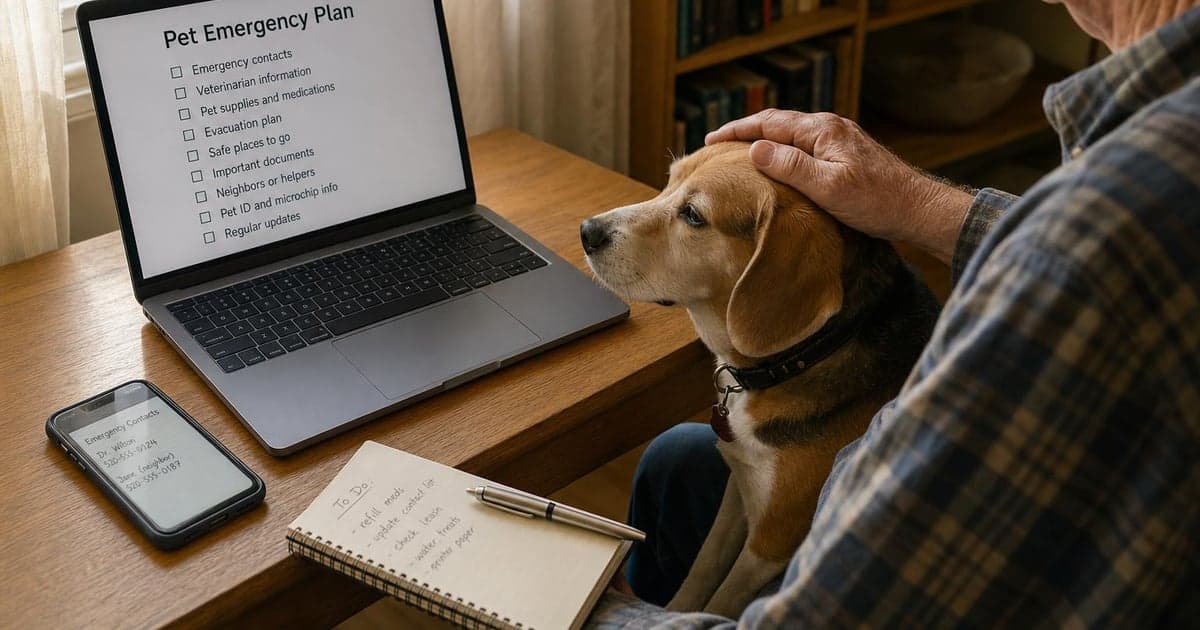
Here is what this plan covers: a named guardian, a funded pet trust, a 72-hour response network, and a daily check-in that triggers the whole chain if something goes wrong. Each piece is straightforward to set up. Together they mean Buddy is covered no matter what happens to you.
Why Solo Pet Owners Face a Unique Risk No One Talks About
If you are an older adult living alone with a pet, you are part of a very large group. According to AARP's 2021 research, approximately 55% of U.S. adults ages 50 and older own a pet. Companion animals are central to daily life for millions of people in this group.
The problem is that most of those owners have made no formal plan for what happens to their animal if they fall, have a stroke, or die at home. Gallup data shows that only about one-third of U.S. adults have a will or other estate planning document. That means the vast majority of pet owners, including most people reading this, have no legal provision for their animals whatsoever.
This is not a character flaw. Thinking about your own incapacitation is uncomfortable. But for someone living alone, the stakes are higher than they are for someone with a household full of people who would notice immediately and step in. Buddy cannot unlock the door or explain that you have not been home since Tuesday morning. If you are hospitalized on a Monday and nobody with a key knows about your dog, that animal is in trouble by Wednesday.
There is also a case to be made that pets are genuinely good for you. The HHS Surgeon General's advisory on social connection identifies social isolation among older adults as a serious public health concern, and pets are widely recognized as a meaningful buffer against loneliness. If a pet plays that kind of role in your daily life, continuity of care for that animal is worth taking seriously.
Framing this as a planning gap for responsible pet owners, not a warning about what could go wrong with you, is the right way to look at it. You already know the risk exists. This article gives you the exact steps to close it. For more on what your legal options look like at the far end of this scenario, read our full guide on what happens to your pets if you die alone.
Step 1: Name an Emergency Pet Guardian Before You Need One
An emergency pet guardian is not the same as the person who will permanently adopt your dog if you pass away, though that can be the same individual. An emergency guardian is the person activated in the short-to-medium term if you are hospitalized, incapacitated, or otherwise unable to provide care. This distinction matters because the right person for the immediate response role may be different from the right long-term home.
Choosing the right guardian comes down to four things.
Willingness. This one gets skipped constantly. Many people assume a family member or friend "would of course take Buddy." Assumptions are not agreements. You need to have the explicit conversation, confirm that the person understands what they are committing to, and get confirmation in writing. An informal promise made at a holiday dinner is not a plan.
Proximity. Your guardian needs to be able to reach your home quickly. A beloved niece who lives four states away cannot feed your dog tonight if you are taken to the hospital this afternoon. Proximity is not everything, but a guardian who cannot respond within a few hours needs to be paired with a closer backup.
Financial readiness. Temporary pet care costs money. A guardian stepping in should not be personally funding your animal's food, vet visits, and boarding out of pocket. Step 5 covers how to handle this, but the guardian conversation should include a clear understanding that financial support will be arranged.
Compatibility with your animal. Buddy may not be right for every household. A friend with three cats and a small apartment may love you and still not be the right emergency home for a large, energetic dog. Be honest about your animal's specific needs.
Name both a primary and a backup guardian. Put both agreements in writing. Keep that documentation with your other important papers, and tell both people where to find it. As part of your solo aging safety plan, this is one of the highest-value conversations you can have.
Step 2: Create a Pet Care Dossier Your Guardian Can Actually Use
A willing guardian who does not know Buddy's vet, his medications, or the fact that he cannot be near other dogs is not fully equipped to help. Goodwill without information is a starting point, not a plan.
Your pet care dossier is a single document (or folder) that contains everything a guardian needs to take over care immediately, without calling you. Here is what goes in it:
- Veterinarian contact information: Name, clinic, phone number, and address. Include the name of any specialist your animal sees regularly.
- Vaccination and medical records: Either the full records or a summary of current status, including any ongoing conditions.
- Current medications: Name of each medication, dosage, frequency, and what it is treating. Include the pharmacy or vet office where refills are obtained.
- Microchip number: This is how your animal is identified if separated from your guardian.
- Feeding schedule and dietary needs: How much, how often, any foods that must be avoided, and any supplements.
- Behavioral notes: What your guardian needs to know to keep Buddy safe and comfortable. Fear triggers, leash behavior, whether he is good with strangers, any medical quirks like a tendency to eat foreign objects.
- Pet insurance details: Policy number, provider, and how to file a claim.
- Daily routine: When Buddy eats, walks, and sleeps. A familiar routine reduces stress for an animal in a disrupted situation.
Keep a printed copy posted at home in a place a guardian or first responder would find it (inside a kitchen cabinet door works well). Share a digital copy with your primary guardian and at least one backup contact. FEMA's guidance on planning for pets in emergencies reinforces that documented care information is a core component of any household emergency plan.
Step 3: Set Up a Pet Trust So Your Animal Is Legally and Financially Protected
Leaving a dog to someone in a will sounds like a reasonable plan. It is not, legally speaking. Under U.S. law, pets are classified as property. Property cannot inherit money. If your will says "I leave Buddy to my neighbor Janet, and I leave $5,000 for his care," that $5,000 has no legal mechanism to follow Buddy. Janet receives the dog (if she accepts), but she has no enforceable claim to the funds you intended for his care.
A pet trust solves this. As the American Bar Association explains, all 50 U.S. states and Washington D.C. now recognize pet trusts as enforceable legal instruments. A pet trust designates specific funds for your animal's care, names a trustee to oversee how those funds are spent, and gives your guardian actual financial resources to act, not just goodwill and an unenforceable promise.
A trustee and a guardian can be the same person or different people. Many estate attorneys recommend separating the roles: the guardian cares for the animal day to day, and the trustee manages and releases funds. This creates a basic accountability check.
How much should the trust be funded? That depends on your animal's age, health, and likely lifespan, and on your local costs for food, veterinary care, grooming, and boarding. A working estimate starts with your current annual spend on your pet and multiplies by the expected remaining years of your animal's life, with a buffer for unexpected medical costs. Your estate attorney can help you arrive at a number that makes sense.
Two important caveats. First, enforceability and trustee oversight requirements vary by state. A pet trust that is solid in one jurisdiction may have gaps in another. Work with a local estate attorney, not a generic online template. Second, a pet trust handles the long-term and end-of-life scenario. You still need the 72-hour network described in the next section for the short-term gap. For more detail on your legal options for protecting your pet across different scenarios, that full guide covers the territory well.
Step 4: Build a 72-Hour Emergency Response Network
A pet trust and a named guardian handle the long-term scenario. But what about the first 72 hours after a hospitalization, before your guardian can step in? This gap is where many plans fall apart completely.
Think in three tiers.
Tier 1: Same-day, within hours. This is a neighbor, a friend on your street, or someone nearby who has a spare key to your home and knows about Buddy. Their job is simple: get to your home, confirm the animal is safe, provide food and water, and make contact with your guardian. This person does not need to be a pet expert. They need to be close, available, and already have the key.
Tier 2: Short-term coverage (days 1 to 3). A local pet-sitter or boarding facility that you have pre-approved and pre-registered with. Pre-registration matters because a boarding facility that has never heard of you or your dog may not accept an animal in an emergency situation on short notice. Call your preferred facility now, explain that you are an older adult living alone, and ask about their emergency boarding protocol. Many have one. Pay for a short trial stay so Buddy is familiar with the environment before he needs it.
Tier 3: Veterinary emergency boarding. Many vet clinics offer short-term boarding for established clients. If your dog has a medical condition that requires attention, this tier ensures he is in a supervised setting with access to care. Confirm this option with your regular vet and note it in your pet care dossier.
FEMA's guidance on planning for pets in emergencies supports the broader logic of layered response networks for pet owners, noting that failure to plan for animals causes people to make unsafe decisions in crisis situations. The same principle applies at the individual level: a layered plan gives everyone in your response chain a clear role.
Step 5: Fund and Document Vet Care So Bills Don't Stop Treatment
Your guardian may love Buddy and be willing to step in immediately. But if they arrive at the vet clinic with an animal in distress and no authorization to consent to treatment, and no payment method on file, care can be delayed or refused. That is a fixable problem.
Three mechanisms work together here.
A standing vet authorization letter. This is a signed, dated letter on file with your veterinarian that grants your named guardian (and your backup guardian) explicit permission to consent to medical treatment on your pet's behalf. Your vet clinic likely has a standard form for this. If they do not, ask your estate attorney to draft a simple one. Keep a copy in your pet care dossier.
A prepaid or pre-authorized account at your vet clinic. Many clinics will hold a credit card on file for an established client. Ask your clinic whether you can designate your guardian as an authorized user on that account, or whether you can pre-fund a care balance. Policies vary by practice. Have this conversation directly with your clinic's front office.
A pet emergency fund or pet insurance policy. A dedicated savings account earmarked for Buddy's care, with your guardian listed as an authorized signatory, is a clean and flexible solution. Pet insurance is a parallel option, particularly if your animal has a chronic condition with predictable ongoing costs. Whichever you choose, confirm that your guardian knows the account exists, knows how to access it, and is named as an authorized contact with the insurer if applicable. The American Bar Association's guidance on pet trusts reinforces that money and legal authority need to be in place before an emergency, not scrambled together during one.
How a Daily Check-In Call Fits Into Your Pet Emergency Plan
Every piece of this plan works well. The weak link is detection lag: the gap between when something goes wrong and when anyone knows about it.
If you fall on a Tuesday morning and no one calls until Thursday, Buddy goes close to 48 hours without food, water, or care. Your guardian cannot activate your response chain if your guardian does not know anything has happened. Your tier-one neighbor cannot check on your dog if no one has told them to. The plan is solid, but the trigger is missing.
A daily check-in call service closes that gap. The structure is simple: you check in each day, and if you miss a check-in, a designated response chain is contacted. For Buddy, that means your tier-one neighbor and your guardian are notified within hours, not days. The animal gets care while the situation is assessed. Everything you built in steps 1 through 5 is activated by the one mechanism that detects the problem in the first place.
This is the role AloneAssist plays in a pet emergency plan. A short daily call, completed in under a minute, creates a structured trigger that puts your whole response chain in motion the moment something goes wrong. It is not a medical device. It is not a tracking system. It is a daily routine with a built-in consequence if it does not happen.
Worth noting: there is no peer-reviewed literature specifically linking daily check-in calls to improved outcomes for pets when owners are incapacitated. The logic here is practical and straightforward. Detection lag is the gap. A daily check-in is a reliable way to close it. You can see how daily check-in services for seniors compare to one another, or read a direct breakdown of how AloneAssist compares to other services to understand what differentiates them.
Putting It All Together: A One-Page Pet Emergency Plan Checklist
This is the complete plan. You can print this list, fill it in during one afternoon, and have a finished system by end of day.
Guardian and legal:
- Named primary emergency guardian (written agreement in hand)
- Named backup emergency guardian (written agreement in hand)
- Pet trust established with a local estate attorney, funded appropriately
- Vet authorization letter signed and on file at your clinic
Documentation:
- Pet care dossier completed (vet contacts, medications, feeding schedule, behavioral notes, microchip number, insurance details, daily routine)
- Physical copy posted at home in a visible location
- Digital copy shared with primary guardian and backup contact
72-hour response network:
- Tier-1 neighbor or nearby contact identified, given a spare key, and briefed
- Local pet-sitter or boarding facility pre-registered and pre-approved
- Veterinary emergency boarding option confirmed with your regular clinic
Financial:
- Emergency fund or pet insurance active, with guardian named as authorized contact
- Prepaid or pre-authorized account at vet clinic set up
Detection:
- Daily check-in system in place (this is what activates everything else)
Each item on this list is a single task. Most take less than an hour. The full checklist is a half-day's work, and then it is done. For the broader framework around living independently and planning for contingencies, the solo aging safety plan covers more ground beyond pets.
The Emotional Case: Your Independence Shouldn't Cost Buddy His Security
Frank is not building this plan because he is giving up. He is building it because he is a responsible owner who thinks ahead.
Staying independent is not just a preference. For many older adults, it is the organizing principle of a whole life. But independence has a shadow side if it means no one is watching, no one has a key, and no one knows your dog's vet. A gap that you have not planned for is not freedom. It is exposure, for you and for Buddy.
According to AARP's 2021 survey, pets are central to the daily routines and emotional wellbeing of a majority of older adults in this country. You already know what Buddy means to your day. This plan is how you protect that, and him, from a single bad morning undoing everything.
Good owners think ahead. You are doing that now. Set this up once, and it holds.
Frequently Asked Questions
What is a pet emergency plan for seniors living alone?
A pet emergency plan is a documented set of arrangements, including a named guardian, an established pet trust, funded vet care, and a layered response network, that ensures your pet is fed, housed, and cared for if you are hospitalized, incapacitated, or die. Think of it as the pet-owner equivalent of a medical directive: something you set up once so it works automatically when needed.
Are pet trusts legally valid, and do I need one?
Yes. All 50 U.S. states and Washington D.C. now recognize pet trusts as enforceable legal instruments. A pet trust is more reliable than simply mentioning your pet in a will, where pets are classified as property and cannot inherit money, because it designates specific funds for your animal's care and names a trustee to oversee spending. Enforceability details vary by state, so consulting a local estate attorney is the right move before finalizing any documents.
Who should I name as my pet's emergency guardian?
Choose someone who is willing (confirm this explicitly, in writing), lives close enough to respond quickly, is financially stable enough to participate in care, and is compatible with your specific animal's temperament and needs. Name a primary and a backup guardian. Informal promises are not reliable in a crisis. Written agreements are.
How does a daily check-in service help protect my pet?
The biggest gap in most pet emergency plans is detection lag: nobody knowing something is wrong until days have passed. A daily check-in call service creates a structured trigger. If you miss your check-in, your response chain, your guardian, your tier-one neighbor, your emergency contact, is activated within hours rather than days, giving Buddy the fastest possible path to care.
What should go in a pet care document?
Your pet care dossier should include your veterinarian's name and contact information, vaccination and medication records, your pet's microchip number, feeding schedule and dietary restrictions, behavioral notes, pet insurance details, and your pet's daily routine. Keep a printed copy at home in a visible location and share a digital copy with your guardian and at least one backup contact.
Wondering how AloneAssist fits into a pet emergency plan and how it compares to other check-in services? See a direct side-by-side comparison now.