You already know this matters. The question isn't whether to plan: it's knowing exactly what to set up, in what order, so your pet is protected whether something happens tomorrow or twenty years from now. This article gives you that framework, start to finish.
This Worry Isn't Morbid: It's Responsible
Lying awake at 2 a.m. thinking about who feeds your dog if something happens to you isn't catastrophizing. It's the kind of clear-eyed thinking that responsible solo pet owners do: and then, ideally, actually act on.
Millions of people live alone with a pet as their only daily companion. The worry is widespread, legitimate, and almost never talked about plainly. Most planning conversations focus on wills, finances, and medical directives. The animal waiting in the other room rarely comes up until it's too late.
Here's what this article will hand you: the legal tools that provide long-term protection, the practical tools that cover the gap before legal documents even apply, and a step-by-step framework you can start building today. Some of it requires an attorney. Some of it requires a wallet card and a phone call. All of it is practical, not morbid: and every step is an act of love, not a legal formality.
By the end, you'll know exactly what to do and in what order. Let's get into it.
The Hard Reality: What Actually Happens to Pets When a Solo Owner Dies
Here's the default scenario when a solo pet owner dies without any plan in place: nothing good happens automatically.
Under U.S. law, pets are classified as personal property. That means when you die, your animal becomes part of your estate: like your furniture or your car. Whoever administers your estate, whether that's a court-appointed executor, a distant relative, or a public administrator, takes legal control. That person has no obligation to prioritize your pet's welfare. They are not required to find a loving home, keep the animal out of a shelter, or even ensure it's fed while the estate is being sorted.
Well-meaning family members or friends can't simply walk in and take your dog or cat, either. Without documentation granting them that right, they have no legal standing to claim the animal from the estate. Even if everyone agrees your neighbor would be the best person to take your cat, the estate administrator's authority overrides informal agreements.
The Humane Society of the United States estimates that hundreds of thousands of pets enter shelters each year after their owners die or become incapacitated: a number that reflects how common this planning gap is. That figure is an estimate, not a tracked federal statistic, but the pattern it points to is real and well-documented by shelter intake workers across the country.
The good news: this default outcome is entirely avoidable. The legal tools exist. The practical tools exist. You just have to set them up before they're needed.
Pets Are Property Under U.S. Law: Here's Why That Matters
The personal property classification isn't a technicality: it has real consequences for what protections your pet does and doesn't have after you're gone.
A child has legal rights. A named human beneficiary in a will has enforceable claims. Your pet has neither. Without a specific legal instrument naming a caregiver and allocating funds for the animal's care, a court has no framework that requires anyone to look out for your pet's welfare. The estate process will move forward focused on distributing assets: and an animal without a named recipient is just another item to be resolved.
The American Bar Association notes that pets being classified as property is precisely why specialized legal tools like pet trusts exist: they create an enforceable framework within the property law system that standard wills can't fully provide on their own. A will can name a caregiver for your pet, but a pet trust can fund that care, specify how the animal should be treated, and give a trustee legal standing to enforce those wishes.
This is also an area where the law is evolving: and evolving quickly. Estate planning norms around pets have shifted significantly in recent years, and what was considered legally unusual a decade ago is now mainstream. That's worth knowing because it means an estate attorney you consult today will likely have more tools available than one you might have spoken to five years ago.
One important caveat: while the legal frameworks described here apply broadly across the United States, the specific details of how pet trusts are enforced and overseen vary meaningfully from state to state. The right answer for you depends on where you live, and a consultation with an estate attorney familiar with your state's laws is essential before finalizing any plan.
The Pet Trust: The Most Legally Secure Tool You Can Set Up
A pet trust is exactly what it sounds like: a legal trust established specifically to provide for your pet's care after you're incapacitated or die. It's not an exotic legal instrument: it's a straightforward estate planning tool that all 50 U.S. states now have enabling statutes for, meaning it's available to you regardless of where you live.
The American Bar Association identifies the pet trust as the most legally secure mechanism available for funding and directing a pet's care. Here's why: unlike a will provision, which expresses your wishes but depends on goodwill and probate timelines to execute, a pet trust is a binding legal structure. The trustee has an enforceable obligation to use the trust funds for your pet's care according to your instructions. A named caregiver receives the animal. The terms of care are legally documented.
The three core elements of a pet trust:
-
A named trustee: the person or institution responsible for managing the trust funds and ensuring the caregiver follows your instructions. This can be a trusted friend, a family member, or a professional trustee. The trustee and the caregiver are often different people, which creates a layer of accountability.
-
A named caregiver: the person who will actually live with and care for your pet. This person should be someone you've explicitly asked and who has explicitly agreed. Don't assume. Confirm it.
-
Funded account: the trust needs money in it to work. You designate an amount to cover food, veterinary care, grooming, boarding, and other expenses for the animal's anticipated lifespan.
What to include in your care instructions:
- Feeding schedule and food brand/type
- Medication schedules and prescribing veterinarian's contact information
- Daily routines (walks, play, sleep preferences)
- Behavioral notes (fears, triggers, known health issues)
- Preferred veterinary clinic and any specialists
- What you want to happen if the caregiver can no longer serve
Costs for drafting a pet trust vary by attorney and state, but expect a range from a few hundred dollars to over a thousand in legal fees, plus whatever amount you fund the trust with. If that's not accessible right now, that's fine: there are lower-barrier starting points covered in the next section. But the pet trust is the destination you're building toward.
Will Provisions and Emergency Care Cards: The Lower-Barrier Starting Points
Not everyone can get to an estate attorney this week. That doesn't mean you're without options: it means you start with what's available now and build toward the more robust tools over time.
Will provision. If you already have a will, or when you draft one, you can include a provision that names a caregiver for your pet. This is less legally airtight than a pet trust: a will provision expresses your wishes, but the pet still passes through the estate, and a caregiver named in a will doesn't have the same enforcement mechanism a trustee does. Still, it's meaningfully better than nothing. It signals clear intent and gives the named person a basis to advocate for taking the animal.
Emergency care card. This is the tool that works before death: during incapacitation, a hospitalization, or any situation where you're suddenly unable to care for your pet. The Humane Society of the United States frames the emergency care card as one of the two foundational tools for solo pet owners, alongside the pet trust. Here's how to make one:
- Use a wallet-sized card (an index card works; laminate it if possible)
- Include your pet's name, species, and location in your home
- Name your designated emergency caregiver and include their phone number
- Include a backup contact in case the primary isn't reachable
- Note any critical medical needs or medications
Carry it in your wallet. Every day. If you're in an accident and taken to a hospital, the people treating you aren't going to check on your dog: but the person who finds this card will know exactly who to call.
The emergency care card fills a gap that legal documents can't: it activates immediately, the moment someone finds it, without waiting for a death certificate, a probate process, or a court order. For the hours before anyone knows what's happened, this card may be the most important thing you have.
The Gap No Document Fills: The Hours Before Anyone Knows
Here's the planning reality that most articles skip: legal documents kick in after your death is confirmed and an estate process begins. That can take days: sometimes longer.
A will names a pet caregiver. A pet trust funds their care. An emergency care card signals to first responders who to call. All of these are valuable. None of them solve the problem of the 12 to 72 hours when no one knows anything is wrong.
If you live alone and have a medical emergency at home: a fall, a stroke, a cardiac event: the clock starts running immediately. Your pet is inside. No one is coming. The animal may have no access to food, water, or needed medication. If your pet requires daily medication, the stakes are higher still.
This is the gap Frank's 2 a.m. fear is actually pointing at. It's not abstract. It's the specific window between "something happens" and "someone finds out." Legal documents don't touch that window. Community goodwill doesn't reliably touch it either.
What closes this gap is a system that notices you're missing: quickly: and sends a fast trigger to someone who can act. That's what daily check-in services are designed to do, and it's why they matter just as much to your pet as they do to you.
Daily Check-In Services: How They Double as a Pet Safety Net
Here's how a daily check-in service works: you check in each day, typically by phone call. If you miss your check-in, a designated contact: someone you've named in advance: is alerted. That alert goes out within hours, not days.
The direct benefit is clear: if something happens to you, someone finds out fast. But the second benefit matters just as much if you have a pet: that alert becomes an automatic trigger for someone to go check on your animal. Today. Not next week when a neighbor notices your mail is piling up.
This is practical reasoning, not a claim based on formal research: but the logic holds up. A daily check-in system with a named emergency contact who also happens to be your pet's designated caregiver creates a reliable, fast-response chain. You miss a call; the system flags it; your pet's caregiver gets the alert and heads to your home. That's exactly what you need to cover the hours before anyone knows.
A few practical notes on making this work:
- The designated contact in your check-in system should also be named on your emergency care card. These two tools reinforce each other. If the check-in alert goes out and the contact is already holding a care card with your pet's information, they know what to do immediately.
- Confirm this arrangement explicitly. Don't assume a friend or family member is comfortable serving as both check-in contact and emergency pet caregiver. Have the conversation. Get a clear yes.
- Give your check-in contact a key or access method. An alert that your pet needs help is only useful if the person receiving it can get through your front door.
A daily check-in service isn't just for you. It's the safety net your pet is counting on, too.
Build Your Pet Emergency Network: A Step-by-Step Framework
You can start this today. None of the first five steps require an attorney.
1. Identify and confirm a primary emergency pet caregiver. Pick someone specific. Ask them directly. Get an explicit yes. Don't rely on someone who "would probably help": you need someone who has agreed and knows what they're agreeing to.
2. Create an emergency care card and carry it in your wallet. Include your pet's name, species, home location, your caregiver's name and phone number, and any critical medical needs. Do this today. It takes ten minutes.
3. Put a window decal or door card on your home alerting first responders to pets inside. These are available from humane societies and online. Place one at your front door and one at a back entrance. When first responders arrive, they'll know immediately that an animal is inside that needs attention.
4. Set up a daily check-in system and name your pet caregiver as the alert contact. This closes the gap that no legal document can cover. The faster someone is notified, the faster your pet gets help.
5. Draft or update your will to name a pet caregiver. Even if you don't have a full estate plan yet, a will with a pet care provision is a meaningful step up from nothing. Work with an attorney when you can.
6. Consult an estate attorney about a pet trust. This is the most legally secure option available. Given that all 50 states now have enabling statutes, it's accessible wherever you live: but the specifics vary by state. Get state-specific legal advice.
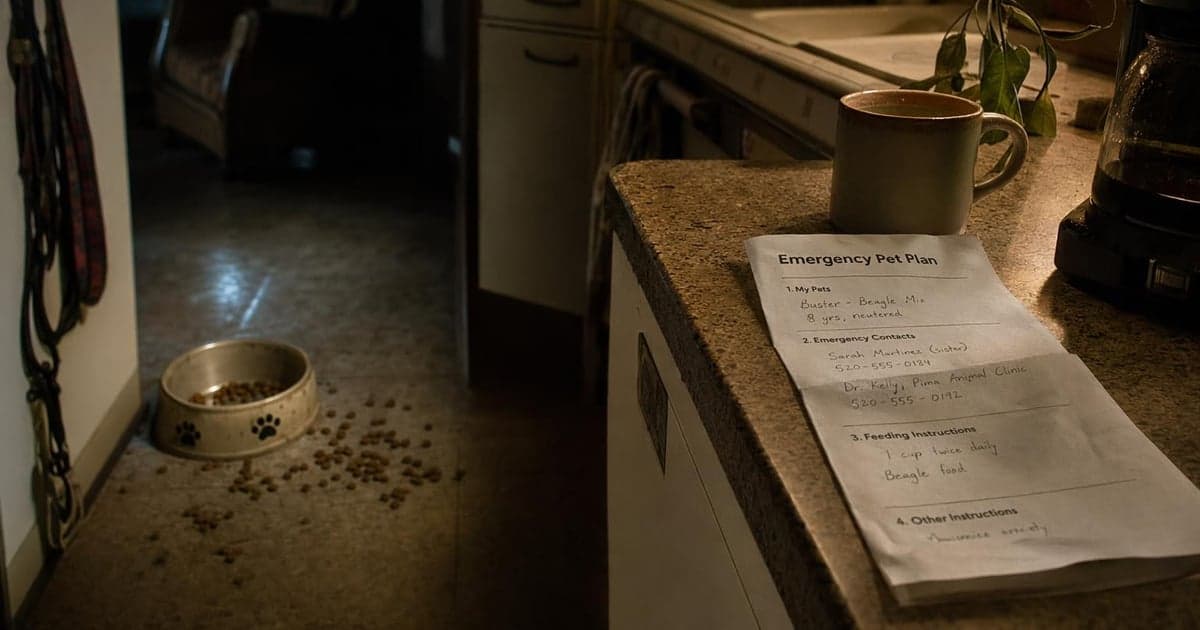
7. Leave detailed written care instructions accessible at home. Keep them somewhere findable: near the pet's food, on the refrigerator, or in a folder labeled clearly for an emergency caregiver. Include feeding schedules, medications, vet contacts, and behavioral notes.
Build this in layers. A care card and a confirmed caregiver today. A will provision soon. A pet trust when you can. Each layer adds protection; none of them cancels the others.
Community and Informal Networks: A Backup Layer, Not a Plan
Neighbors matter. Friendly dog-walkers matter. A community of people who care about you and know your pet matters. These informal relationships are real and worth cultivating.
But a neighbor who "would probably check" is not a plan. It's a hope.
The difference between a backup layer and a plan is documentation and explicit agreement. If you want your neighbor to serve as a secondary emergency contact, tell them that. Give them your pet caregiver's phone number. Make sure they have a way to reach someone fast if they notice something is wrong. Add them to your emergency care card as a backup.
Informal networks work when they're formalized: when the people in them know what role they're playing and how to activate the right response. Without that conversation, goodwill stays potential rather than becoming action. Have the conversation. Build the backup contacts in. Then trust the network you've actually built, not the one you're assuming exists.
Frequently Asked Questions
Q: If I die alone with no will, what happens to my pet?
Without a will or pet trust naming a caregiver, your pet becomes part of your estate as personal property, and whoever administers the estate decides the animal's fate: with no legal obligation to prioritize its welfare. The pet could be surrendered to a shelter or passed to someone who didn't want the responsibility. This is the default outcome for anyone without a plan in place, and it's exactly what the tools in this article are designed to prevent.
Q: Is a pet trust legally valid in my state?
All 50 U.S. states have statutes enabling pet trusts, making them a nationally available legal tool. However, the specifics of enforcement and trustee oversight vary by state, so it's important to consult an estate attorney familiar with your state's laws rather than relying on general guidance alone.
Q: What is an emergency pet care card and how do I make one?
An emergency care card is a wallet-sized document that lists your pet's name, species, home location, and the contact information of a designated emergency caregiver. The Humane Society of the United States recommends carrying one at all times so that first responders or medical staff can alert your pet's caregiver immediately if you're incapacitated: before any legal process begins. It's one of the fastest and lowest-barrier protective steps you can take.
Q: How does a daily check-in service help protect my pet?
A daily check-in service alerts a designated contact if you miss your regular check-in: which means someone is notified quickly if something happens to you, typically within hours rather than days. That fast trigger gives your emergency pet caregiver time to reach your animal before it runs out of food, water, or needed medication. The check-in system closes the gap that exists before legal documents ever come into play.
Q: How much does it cost to set up a pet trust?
Costs vary by attorney and state, but a standalone pet trust typically ranges from a few hundred to over a thousand dollars in legal fees, plus whatever funds you designate for ongoing pet care. For those who can't access a trust immediately, a will provision and a completed emergency care card are meaningful lower-cost first steps that provide real protection while you build toward the full plan.
See how AloneAssist works: and how a daily check-in call can become the safety net your pet is counting on.