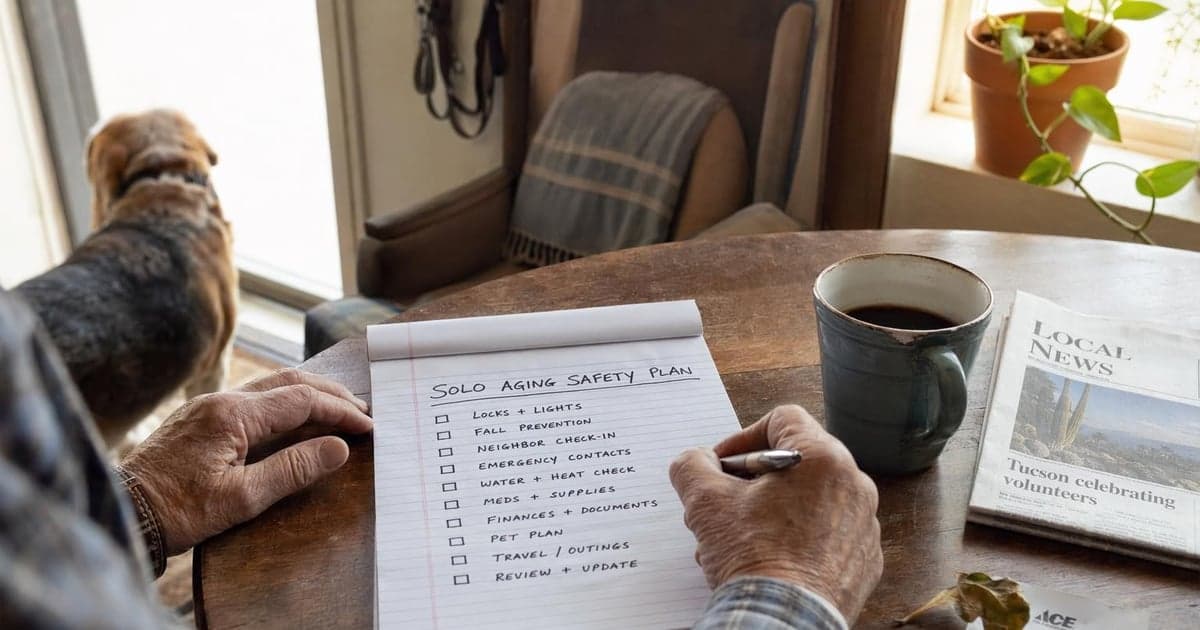
A safety plan isn't an admission that something is wrong. It's what people who intend to stay independent actually do. This guide walks through every component of a complete solo aging safety plan-home, medical, legal, emergency, and daily routine-so you can show your daughter the checklist and watch the conversation shift from "I'm worried about you" to "You've got this covered."
Why a Safety Plan Is Pragmatism, Not Paranoia
Roughly 14.7 million older adults in the United States live alone, according to U.S. Census Bureau household data. That's not a fringe lifestyle. It's a deliberate choice made by a significant share of adults who value their autonomy and have built lives on their own terms.
The Administration for Community Living frames independent living not as the absence of support, but as the ability to direct your own life-with appropriate supports in place when you want them. That distinction matters. Asking for backup isn't a concession. It's how serious people stay in charge.
AARP's research on home and community preferences finds that approximately 77% of older adults want to remain in their own homes as they age, and the factor that separates those who successfully do from those facing reactive crises is planning ahead-not luck, not proximity to family, and not the absence of risk. The people who stay independent longest are the ones who thought it through before anything went wrong.
A solo aging safety plan is that thinking made concrete. It covers every layer-your home, your health records, your emergency contacts, your finances, and your daily rhythm. When it's done, you'll have something you can point to. So will the people who care about you.
Home Safety Fundamentals: Removing the Risks Without Remodeling Your Life
Falls happen most often at home-and they happen to people of all ages and health levels. The CDC reports approximately 36 million falls among older adults each year, resulting in more than 32,000 deaths. That's the stake. Here's the practical response: environmental modifications-grab bars, better lighting, cleared pathways-can reduce fall risk by up to 26% in community-dwelling older adults, according to the same CDC data. The exact benefit varies by individual circumstances, but the direction is clear and the interventions are low-cost.
Lighting Inadequate lighting is one of the most correctable fall risks in any home. Walk every hallway, stairway, and path between your bedroom and bathroom at 2 a.m.-that's the real test. Install nightlights or motion-activated lights along those routes. Replace any burned-out bulbs with higher-lumen equivalents. Add a lamp within arm's reach of your bed so you're never standing in the dark first.
Grab Bars Install grab bars near the toilet and inside the shower or tub. These are the two highest-priority modifications in any home because that's where a disproportionate number of household falls occur. This is not a cosmetic update-it's load-bearing infrastructure. Make sure bars are bolted into wall studs or anchored with appropriate hardware; towel bars are not grab bars.
Bathroom and Kitchen Hazards In the bathroom: a non-slip mat inside the tub or shower, a bath seat or shower bench if you prefer one, and a handheld showerhead. In the kitchen: store frequently used items between waist and shoulder height to avoid reaching overhead or crouching low. A stable step stool with a handle is worth having if you do need to reach up.
Trip-Hazard Removal Walk through every room and remove or secure loose rugs, extension cords crossing foot traffic, and any furniture pushed into walkways. This takes an afternoon, costs nothing, and has immediate impact.
Your home safety checklist:
- Nightlights or motion lights on all nighttime routes
- Higher-lumen bulbs in stairways and hallways
- Grab bars installed at toilet and in shower/tub (bolted to studs)
- Non-slip mat in tub or shower
- Frequently used items between waist and shoulder height
- All loose rugs secured or removed
- Extension cords cleared from walking paths
Medical and Health Documentation: The Paperwork That Speaks for You
Roughly one in three adults has completed any advance directive, according to KFF survey data on end-of-life planning. That means the majority of people living alone have not documented what they want if they can't speak for themselves. Think of completing yours as a competitive advantage: your wishes are on record, and no one is guessing.
There are four documents every solo ager needs. Together, they form the paperwork that speaks for you.
1. Advance Directive / Living Will This document records your specific medical treatment preferences in writing-whether you want resuscitation, mechanical ventilation, feeding tubes, or other interventions if you're incapacitated. It removes the burden of impossible decisions from the people who care about you and ensures your preferences are followed, not assumed.
2. Healthcare Proxy / Durable Medical Power of Attorney Where a living will records what you want, a healthcare proxy designates who you trust to make decisions if your situation falls outside what the living will explicitly covers. Ideally, you have both. The named person should know they're named and understand your values-not just hold the paperwork.
3. Current Medication List A printed, dated list of every medication you take-prescription and over-the-counter-with dosages and prescribing doctors. Keep one copy at home in an obvious location and a second copy in your wallet or phone. First responders need this information quickly.
4. Organized Health History and Doctor Contacts Name and contact information for your primary care physician and any specialists, a summary of significant diagnoses or surgical history, known allergies, and your insurance information. A single folder or binder works. A phone photo of that folder's cover page, stored where your trusted contact can find it, adds a useful backup layer.
State law disclaimer: Advance directive forms, healthcare proxy requirements, and POA documents vary significantly by jurisdiction. Use your state's approved forms, and consult a licensed attorney in your state if you have any questions about execution requirements or recognition.
Emergency Response Systems: Building Your Personal Safety Net
No single device or person is your emergency plan. Redundancy-not any one tool-is the principle.
Think of your emergency response system as a stack of layers. If one layer fails, another catches the gap.
Layer 1: Your Smartphone with ICE Contacts "ICE" stands for In Case of Emergency. Add your most trusted contact to your phone under that label, and enable the medical ID feature on your phone's lock screen so first responders can see your critical information without needing your passcode. This costs nothing and takes five minutes.
Layer 2: Personal Emergency Response System (PERS) Wearable The wearable alert device market has changed significantly in recent years, and specific products evolve quickly-so this guide focuses on features rather than brand names. Look for: automatic fall detection, GPS location capability, two-way voice communication, and a battery life that fits your routine. A device that stays on the charger when you need it most isn't useful. Find one you'll actually wear.
Layer 3: Trusted Contact with a Written Protocol Identify one or two people who agree to be your point of contact in an emergency. Give them a written protocol-not a conversation, a document-that tells them exactly what to do, in order, if they can't reach you. Who to call, where your key is, where your medical documents are, what your regular schedule looks like. They should be able to act without hesitation because they've already read the plan.
Layer 4: Defined Check-In Cadence Your check-in system needs a missed-contact protocol-a specific, agreed-upon response when a check-in doesn't happen. "Call if you don't hear from me by noon" is a plan. "We'll figure it out if something seems off" is not.
The ACL's framing applies here directly: this isn't about being watched. It's about having a structured system that keeps you in control-and gives others a clear, limited role when it matters.
Financial and Legal Readiness: Protecting the Life You've Built
The American Bar Association's guidance on advance planning is direct: a durable power of attorney is the single most important legal document a person living alone can have. Without it, courts-not the people you trust-make financial and healthcare decisions if you become incapacitated. That's not a hypothetical risk. It's the default outcome when no document exists.
Durable Power of Attorney (Financial and Healthcare) A financial durable POA authorizes a named person to manage your bank accounts, pay bills, and handle financial transactions on your behalf if you cannot. A healthcare durable POA-distinct from a living will-designates a decision-maker for medical choices. Both documents should be signed, witnessed, and stored where your named agent can actually find them. Your agent should have a copy too.
Will or Trust A current will ensures your assets go where you intend. If you have significant assets or complex distribution wishes, a revocable living trust may be more appropriate-an estate planning attorney can advise on which fits your situation. The key word is current: a will written before major life changes may not reflect your actual intentions.
Accessible Account Summary Create a sealed document that a named, trusted person can access in an emergency. This is not a password list to hand out freely-it's a located, protected summary of your financial accounts, their institutions, and how to access them under the authority your POA grants. Store it with your other documents, tell your named agent where it is, and review it annually.
Bill Payment Automation Set up automatic payments for recurring essential bills-utilities, insurance premiums, mortgage or rent. One less failure point if you're temporarily unavailable or recovering from an illness.
State law disclaimer applies here as well: POA forms and execution requirements vary by state. Use state-approved forms and have documents reviewed by a licensed attorney in your jurisdiction.
Digital Assets and Pet Contingency: The Details That Get Forgotten
These two categories appear at the bottom of most planning conversations and get skipped entirely. That's a mistake-not because they're life-or-death, but because they create real problems for the people you trust if they're not addressed.
Digital Assets A password manager-a secure application that stores your login credentials-is the cleanest solution for most people. If you prefer a physical document, a sealed envelope stored with your other estate documents works. Either way, whoever has authority under your POA should know how to access it. Beyond passwords, document: recurring subscriptions worth canceling, any significant financial accounts accessed only online, and your preferences for email and social media accounts after death (some platforms have legacy contact features; use them).
Pet Contingency If you have a pet, your safety plan is incomplete without naming an emergency care contact for that animal and providing written care instructions-feeding schedule, vet contact, medications, behavioral notes. Fund a small dedicated emergency account or include a specific bequest in your will that covers your pet's care. This isn't sentimentality; it's a practical loose end that otherwise falls to whoever shows up in an emergency without any guidance.
A note on sourcing: This section draws on practical guidance from estate planning professionals and veterinary organizations rather than peer-reviewed literature-the evidence base here is thin. The planning gaps, however, are real and consistently flagged by practitioners. Treat this as sound practitioner guidance.
The Check-In Routine: Structure That Keeps You in Control
A safety plan isn't a document you file and forget. It's a system you run. The check-in routine is what keeps the system active.
Daily Self-Check Each morning: medications taken, doors locked, brief note in a log or app. This doesn't need to be elaborate. It needs to be consistent. A small notebook on the kitchen counter works as well as any app. The point is a daily confirmation-to yourself-that the system is running.
Weekly Trusted-Contact Call A regular scheduled call with a trusted contact-family member, close friend, or neighbor-gives both of you a reliable rhythm. The call doesn't need to be long. It needs to be expected. When it doesn't happen, the missed-contact protocol you've already written kicks in.
Monthly Plan Review Once a month, spend fifteen minutes with your safety plan. Is the medication list current? Have any contacts moved or changed their availability? Did anything happen this month that should update the plan? An outdated plan can create as many problems as no plan at all.
When to Add a Professional Verification Layer Informal check-ins work well when nearby family or friends are reliably available. They create gaps during travel, periods of recovery from illness, or when your trusted contact's own life makes consistency difficult. A professional daily-contact service adds a structured, documented touchpoint that follows a defined protocol if a response isn't received-escalating to your emergency contacts rather than leaving things to chance.
The ACL's framing of independent living as "directing your own life with appropriate supports" applies here precisely. You design the check-in routine. You decide its parameters. A professional verification layer doesn't replace your system-it confirms it's working on the days when informal backup isn't enough.
You've built the plan. AloneAssist makes sure it's working every day-a consistent, documented check-in that escalates only when it needs to. [See how AloneAssist works →]
Your Solo Aging Safety Plan Checklist
This is the one-page version. Print it, fill it in, and hand it to your daughter. The conversation changes when she can see the plan rather than just hear about it.
HOME
- Motion-activated or plug-in nightlights on all nighttime routes
- High-lumen bulbs in stairways, hallways, and entryways
- Grab bars at toilet and inside shower/tub (anchored to studs)
- Non-slip mat in tub or shower
- Frequently used items stored between waist and shoulder height
- Loose rugs removed or secured; cords cleared from walkways
MEDICAL & HEALTH DOCUMENTS
- Advance directive / living will: signed, witnessed, located
- Healthcare proxy / durable medical POA: agent named and informed
- Current medication list: printed copy at home and in wallet
- Health history folder: diagnoses, allergies, doctor contacts, insurance
- State-specific forms verified; attorney consulted if needed
EMERGENCY RESPONSE
- Smartphone ICE contact and medical ID enabled
- PERS wearable selected and worn (fall detection, GPS, two-way voice)
- Trusted contact(s) identified, role explained, written protocol delivered
- Missed-contact protocol defined and documented
- Spare key in trusted contact's possession
FINANCIAL & LEGAL
- Durable financial POA: signed, located, agent has a copy
- Current will or trust: reviewed within the last three years
- Accessible account summary: sealed, located, agent knows where it is
- Essential bills set to automatic payment
- State-specific legal forms verified
DIGITAL & PET
- Password manager active, or sealed credential document located with estate documents
- Recurring subscriptions listed for cancellation
- Social media and email account legacy instructions documented
- Pet emergency contact named and informed
- Written pet care instructions on file
- Pet emergency fund or will bequest in place
ROUTINE
- Daily self-check habit established (medications, log entry)
- Weekly trusted-contact call scheduled
- Monthly plan review on the calendar
- Professional daily check-in service evaluated; decision made
You've built the plan. AloneAssist makes sure it's working every day-a consistent, documented check-in that escalates only when it needs to. [See how AloneAssist works →]
Frequently Asked Questions
What's the difference between a living will and a healthcare proxy? A living will records your specific medical treatment preferences in writing-resuscitation, mechanical ventilation, feeding tubes, and similar decisions. A healthcare proxy designates a person to make decisions on your behalf if you cannot speak for yourself and the situation falls outside what your living will explicitly addresses. Ideally, you have both documents in place so there's no gap between what's written and what's decided.
How often should I update my solo aging safety plan? Review your plan at least once a year, and immediately after any significant change-a new medication, a move, a health diagnosis, or a change in a trusted contact's availability. The monthly review habit built into the routine section above handles most of this automatically. An outdated plan can create as much confusion as no plan at all.
Do I really need a professional check-in service if I already call a family member every day? Daily family calls are valuable-but they depend on both parties being available and consistent. A professional check-in service provides a documented daily touchpoint with a defined escalation protocol if a response isn't received. That reliability gap matters most during travel, illness recovery, or whenever your informal network has its own competing demands.
What home modification should a solo ager prioritize first? Bathroom safety-grab bars near the toilet and inside the shower or tub-is the highest-priority modification because bathrooms account for a disproportionate share of household falls. Good lighting along your nighttime routes is a close second and requires minimal expense or installation effort.
Is a durable power of attorney the same in every state? No. POA forms, witnessing requirements, notarization rules, and the scope of authority vary significantly by state. Use your state's approved form, and have the document reviewed by a licensed attorney in your jurisdiction to confirm it will be recognized when it's needed.