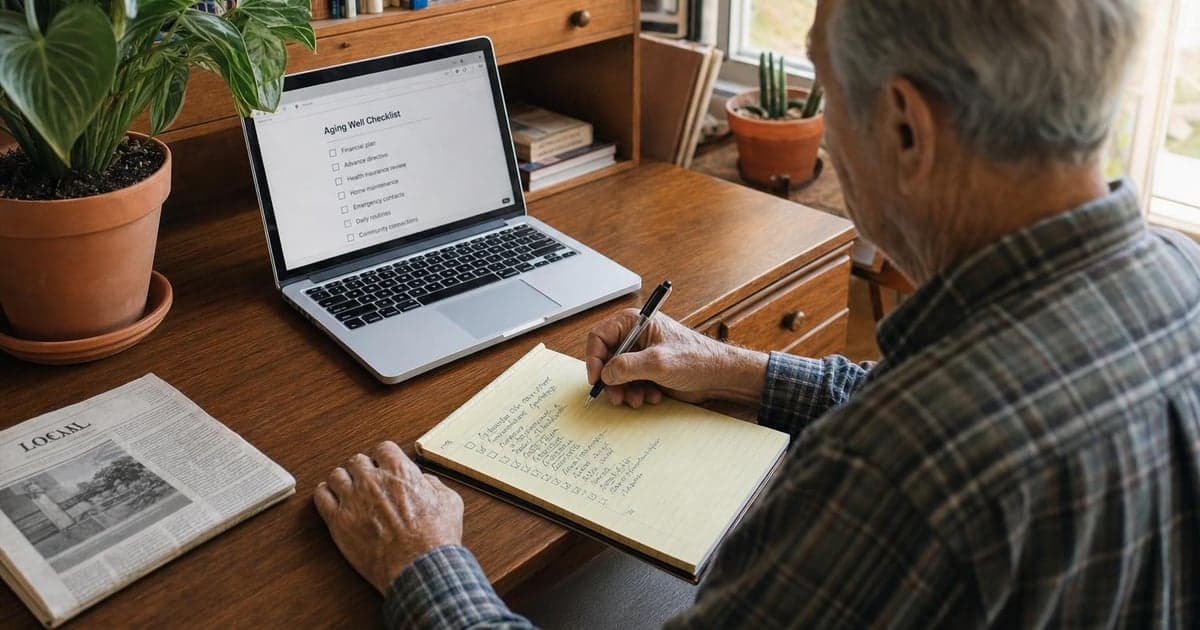
Aging without nearby family is more common than most people realize, and it calls for a different kind of preparation, not panic. The goal of this roadmap is simple: get a real safety net in place, on your own terms, before crisis forces the issue. What follows covers four practical pillars, legal and financial clarity, community anchors, home safety systems, and a daily check-in rhythm, so you can move from ambient dread to a concrete plan you control.
According to U.S. Census Bureau data published at census.gov/newsroom/facts-for-features/2023/older-americans-month.html, roughly 27% of adults 65 and older in the United States live alone, which works out to approximately 14.7 million people. That number is not a sign of failure. It is a fact of modern life, and it is a reason to architect your own system now.
Why Solo Agers Face a Distinct Set of Risks, and Why Planning Changes Everything
A "solo ager" is someone who is aging without a nearby family member who would naturally step in during a health event or emergency. Living alone and being socially isolated are not the same thing: plenty of solo agers have rich social lives and strong community ties. The distinction matters because the risks worth planning around are specific, not general.
Here are three concrete gaps that planning closes.
First, falls. The National Council on Aging, drawing on federal health data, reports that approximately 36 million falls occur among older adults in the United States each year, making falls the leading cause of both fatal and nonfatal injuries in this age group. Prevention, as the NCOA frames it, is largely within individual control.
Second, social isolation. The 2020 National Academies of Sciences, Engineering, and Medicine consensus report on social isolation and loneliness in older adults links social isolation to a 50% increased risk of dementia, along with elevated risk of heart disease and stroke. These are associations, not certainties, but they are robust enough to treat community connection as a genuine health strategy.
Third, the legal vacuum. When no obvious family decision-maker exists, medical staff facing an emergency default to standard protocols that may have nothing to do with what you actually want. Documentation closes that gap, and you will see exactly how in the next section.
Every item on this roadmap is a lever you control right now, not a concession to anything. For a broader framework on building resilience as a solo ager, see the Solo Aging Safety Plan, which complements this roadmap with additional strategy.
Step 1: Get Your Legal and Financial House in Order
The National Institute on Aging states clearly at nia.nih.gov/health/advance-care-planning/advance-care-planning-healthcare-directives that advance care planning is especially critical for people who do not have a readily available family decision-maker, because without documentation, medical staff default to emergency protocols that may not reflect your wishes. That sentence is worth sitting with.
The three documents you need are a will, a durable power of attorney, and a healthcare directive (also called a living will or advance directive). The will covers your assets. The durable POA names someone to make financial decisions if you cannot. The healthcare directive names someone to make medical decisions and records your preferences for treatment. Without all three, someone else, possibly a court or a hospital, makes those calls for you.
AARP data published at aarp.org/money/investing/info-2017/half-of-adults-do-not-have-wills.html indicates that roughly half or fewer U.S. adults have these documents in place. If you are in that group, this is your highest-leverage starting point.
Where to store these documents:
- Originals go in a fireproof box at home.
- Scanned copies go in a secure cloud folder (a password manager or encrypted drive works).
- At least one trusted person knows exactly where to find them and has a copy of the healthcare directive.
Financial resilience:
Consolidate to one or two bank accounts if you currently have several scattered. Set up autopay for recurring bills: utilities, insurance, subscriptions. Name a trusted contact at your brokerage, a formal option most financial institutions offer, so someone can flag unusual activity without having full account access. The goal is to reduce the number of things that require active management if you are ever incapacitated for even a few weeks. Simpler is more resilient.
Step 2: Build Your Informal Safety Network Before You Need It
The 2020 National Academies consensus report on social isolation makes a case that community connection is a health imperative, not a social nicety. For solo agers, the informal network also functions as a practical safety system: the people who notice when something seems off.
Think of it in three tiers.
Tier 1: The first-responder tier. This is one trusted neighbor or friend who has a spare key and a clear understanding that if they do not hear from you for a set period, they check. This person is your most important logistical asset. One trusted neighbor with a spare key does more practical good than any app you have not set up yet. Start there.
Tier 2: The regular-contact tier. These are the people and groups where your absence would be noticed in a day or two. A faith community, a senior center, a regular poker game, a gym class, a hiking club. The specific form does not matter. What matters is that someone in a group would notice if you did not show up and would make a call to find out why.
Tier 3: The ambient-eyes tier. These are regular service providers who see you on a schedule: your barber, your pharmacist, your mail carrier, your primary care physician. They are not your safety net in the same way as a trusted friend, but they are an informal early-warning layer.
How to ask without making it awkward. Most people respond well to a practical, mutual framing. Something like: "I want to set up a simple check-in system since I live alone. If I do not respond to a call or text within 24 hours, would you be willing to reach out to [backup contact]? I am happy to do the same for you." Frame it as logistics, not as a request for emotional support. For men especially, framing this as a practical system rather than a social overture tends to land better.
Step 3: Audit Your Home for Safety Now, Not After a Fall
The NCOA, citing federal health data at ncoa.org/article/get-the-facts-on-falls-prevention, frames fall prevention as a combination of home modification, exercise, and medication review: actionable steps that are largely within your control. The time to make these changes is before a fall, not after.
The home audit checklist:
- Remove or secure loose rugs, especially in hallways and the bathroom.
- Install grab bars in the shower and beside the toilet. This is a 30-minute project with the right hardware.
- Check stair railings: they should be solid and run the full length of the stairs.
- Improve lighting in hallways and the path from bed to bathroom. A motion-activated night light costs under $15.
- Clear clutter from walking paths.
Medication review. Polypharmacy (taking multiple medications) is a documented fall risk. Bring your full medication list to your next primary care appointment and ask specifically whether any combination increases fall risk or affects balance. This is a straightforward clinical question your doctor can answer in minutes.
Medical alert device. Frame this as "when" rather than "if." The value of a medical alert device is highest before a fall or health event: after one, it may already be too late to set up the habit. Devices range from basic push-button pendants to GPS-enabled wearables that detect falls automatically. Choose based on your activity level and how often you are away from home. For a detailed look at device options and how they integrate into a broader safety system, see technology that helps seniors stay home longer.
Emergency contact list. Put a printed list on the refrigerator and save it as the wallpaper on your phone's lock screen. Include your primary care physician, your designated decision-maker, a backup contact, and your medication list summary. First responders are trained to look at the fridge. Make it easy for them.
For a comprehensive walkthrough of home modifications and independence-preserving strategies, the aging in place safely guide covers the full picture.
Step 4: Set Up a Daily Check-In Ritual That Has a Backup
A check-in only works as a safety net if absence is noticeable and triggers a specific action. That means the ritual needs two things: consistency and a defined backup when Plan A does not happen.
Think of this as redundancy by design, not a hedge against failure.
The option stack:
(a) Standing call or text with a friend or neighbor. A daily or every-other-day text exchange with someone who knows to escalate if they do not hear back by a set time. Simple, free, and human. The weakness is that both parties have to stay consistent, and life interrupts.
(b) An automated daily check-in service. AloneAssist makes a daily call at a time you choose. If you do not respond, a designated contact is alerted. The call is a chosen rhythm, not a check-up. You pick the time, you pick the contact, you stay in control. This is the practical alternative to depending entirely on a friend's availability every single day.
(c) App-based wellness check-ins. Several apps allow you to check in with a tap; missed check-ins trigger alerts to a contact. These work well for people who prefer a low-friction digital option.
Build in redundancy. Name a designated person whose job it is to act if a check-in is missed. That person should know who to call and what the threshold is: one missed call, or two? Decide in advance and write it down.
A note for pet owners. If you have a dog or cat, the animal is an informal welfare-check trigger. A neighbor who feeds the dog when you are traveling becomes a natural first responder at home. Make that relationship explicit: "If you ever come to feed her and something seems wrong, here is who to call."
The clinical literature specifically validating automated daily check-in calls as a medical intervention is still limited. The case for them is practical and logical: early detection of a problem, a consistent rhythm that makes absence visible, and a backup that does not depend on any single person's memory. For solo agers, that combination is hard to replicate any other way.
Curious how a daily check-in call fits into a solo aging plan? See how AloneAssist works, and how it becomes the quiet backstop in your safety net.
Step 5: Build a Healthcare Foundation That Works for You Alone
The goal here is a healthcare setup that does not require a family member to navigate on your behalf.
Primary care. Establish a relationship with a primary care physician you trust, and keep a one-page medical summary in your wallet and on your phone. The summary should include current diagnoses, all medications and dosages, known allergies, and the name and number of your designated decision-maker.
The appointments that protect quality of life. Eye exams, hearing checks, and dental appointments are often deferred because they do not feel urgent. They are. The National Institute on Deafness and Other Communication Disorders reports at nidcd.nih.gov/health/age-related-hearing-loss that hearing loss affects nearly 2 in 3 adults over age 70, and that untreated hearing loss is linked to accelerated cognitive changes. An annual hearing check is a straightforward way to catch something early when options are broadest.
Mental health. Social isolation is a real risk for solo agers, and older men in particular are less likely to seek support when they need it. Normalize a periodic mental health check the same way you normalize a blood pressure check: it is part of knowing what is actually going on. Your primary care physician can be a starting point if you are not sure where to go.
The medication card. Keep a wallet card with your medication list and allergy information. Take a photo of it on your phone. If you are ever in an emergency and cannot speak for yourself, this card does the talking.
This Is a Living Plan, Not a One-Time Checklist
Your needs at 65 are not your needs at 75. This plan is worth revisiting every year, or after any significant health change, because the right setup shifts over time. The goal is not a perfect system on day one. The goal is having something real in place before crisis forces the issue.
Pick one action this week. Call an estate attorney and schedule a document review. Text a neighbor about setting up a check-in. Sign up for a daily check-in call. One low-friction starting point is enough. The rest follows.
For the full framework on living independently on your own terms, the solo aging safety plan is a useful next step.
Curious how a daily check-in call fits into a plan like this? See how AloneAssist works, and how it becomes the quiet backstop in a safety net you build yourself.
Frequently Asked Questions
What should I do first if I have no family nearby as I age?
Start with the two highest-leverage steps: get your legal documents in place (will, durable POA, healthcare directive) and identify at least one trusted person who can act as your first responder in an emergency. These require the least ongoing maintenance and close the biggest gaps immediately.
How do solo agers stay safe living alone?
A layered approach works best. Combine home safety modifications (grab bars, good lighting, a medical alert device), a reliable daily check-in routine, and an informal network of neighbors and regular service providers who would notice if something seemed wrong.
What is a daily check-in call and do I need one?
A daily check-in call is a scheduled contact, from a friend, neighbor, or automated service like AloneAssist, that confirms you are okay and triggers a welfare check if you do not respond. For anyone living without nearby family, it provides a safety backstop that no other single tool replicates.
Is social isolation really a health risk, or is that overstated?
It is well-documented. The 2020 National Academies of Sciences, Engineering, and Medicine consensus report links social isolation to a 50% increased risk of dementia and elevated risk of heart disease and stroke. The association is robust enough that building community connections is a genuine health strategy, not just a feel-good recommendation.
Do I need a medical alert device if I am still healthy and active?
The value of a medical alert device is highest before a fall or health event. After one, it may already be too late to set up the habit. Setting one up while you are healthy means it is already integrated into your routine when you need it most.