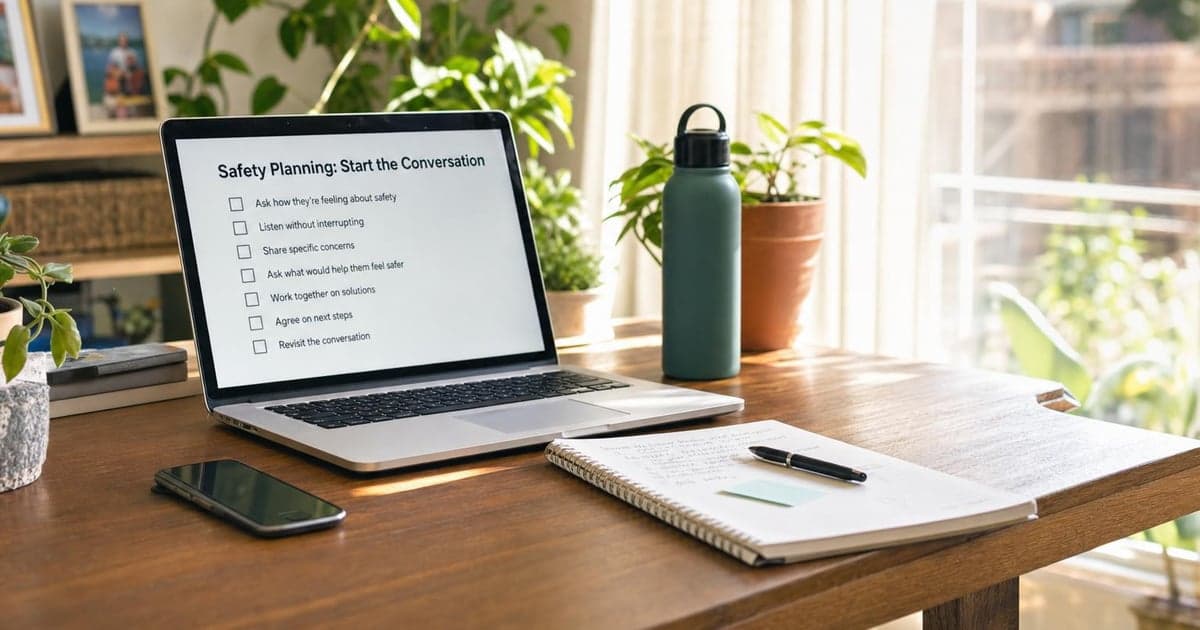
You have played this conversation in your head a dozen times. You know what you want to say. You also know, with near-certainty, how it ends: your parent gets quiet, or sharp, and you spend the next week wondering whether you made things worse. So you put it off again. This article is for that exact moment. Here is a framework, grounded in what actually works, that reframes safety planning as something you build together, not something you impose.
Why These Conversations Go Wrong Before They Even Start
The problem usually isn't what you say. It's the weight you carry into the room.
By the time most adult children try to bring up safety with a parent, they have been sitting on the worry for months. They rehearse, they hesitate, they choose the wrong moment, they abandon the attempt entirely. Then something small happens, a stumble on the stairs, a forgotten appointment, and suddenly they're trying to have a measured conversation while running on fear and accumulated guilt. That combination almost guarantees the conversation will come out louder, more urgent, or more controlling than intended.
You are not alone in this. According to the NAC/AARP "Caregiving in the U.S. 2020" report, roughly 53 million Americans are providing unpaid care to an adult family member or a child with a disability or illness. Among those supporting someone over 50, communication strain and family conflict around care decisions are among the most commonly reported difficulties. The situation is structurally hard, not evidence of personal failure.
What the research on family communication also tells us (and you can read more if you want to feel more prepared for signs your parent may need more support) is that the content of these conversations matters far less than the style. Tone, timing, and whether your parent feels genuinely heard are better predictors of how a conversation lands than the specific words used. Directive or lecture-style approaches reliably produce resistance. That's the core problem to solve.
The fix is not learning a perfect script. It's shifting your posture before you open your mouth.
The Real Reason Your Parent Gets Defensive (And Why It's Not About You)
Here is what is happening on the other side of that conversation.
When you raise a safety concern, even gently, your parent hears something underneath the words: "I think you're losing your ability to manage your own life." That interpretation may be completely wrong, but it is a rational reading of the situation. A child raising safety concerns is a culturally legible signal of a shift in the relationship, and most older adults are acutely aware of what that shift can lead to.
According to the AARP "Home and Community Preferences Survey 2021", nearly 90% of adults 65 and older say they want to remain in their own homes as they age. That is not a preference, it is a priority. Staying home represents autonomy, identity, and continuity. The thing your parent is most actively working to protect is the same thing a safety conversation implicitly puts on the table.
So when your parent goes quiet, changes the subject, or says "I'm fine, stop worrying," they are not being irrational or stubborn. They are protecting something that matters enormously to them. The defensiveness is self-protective, and it's aimed at the situation, not at you personally.
This reframe matters because it changes what you're doing in the conversation. You are not trying to overcome resistance. You are trying to demonstrate that your goal and your parent's goal are the same: keeping them in control of their own life, in their own home, for as long as possible. Once that alignment is visible, the dynamic shifts.
Reframe the Whole Conversation: From "Risk" to "Staying in Control Longer"
The most practical thing you can do before any conversation is swap out the language you're planning to use.
Compare these two openings:
- "I'm worried you're going to fall and no one will know."
- "I want to figure out what would help you stay in your home longer."
Both sentences come from the same place of caring. But the first one centers a frightening image and implies your parent is in danger. The second one centers their goal and invites collaboration. The CDC's fall prevention framework makes exactly this point: fall prevention is most effective when it's framed as a pathway to sustained independence, not as a response to incapacity. That is language you can borrow directly.
The language shift is not cosmetic. It changes the structure of the conversation. "I'm worried" invites your parent to reassure you, or to resist you. "What would help you stay here longer?" invites your parent to answer a question they actually want to answer.
Some additional substitutions worth making:
- Instead of "I think you need help," try "what would make things easier for you at home?"
- Instead of "what if something happens and you're alone?" (which puts risks of a fall when no one is around in the foreground as a threat), try "what would help you feel comfortable if something unexpected came up?"
- Instead of "we need to talk about your safety," try "I'd love to hear what feels manageable and what feels harder these days."
One honest caveat: this framework reflects patterns that are common in English-speaking, majority-culture U.S. families. Family decision-making norms vary significantly across cultures. In some families, children taking an active role in a parent's planning is expected and welcome. In others, it can feel presumptuous or disrespectful regardless of framing. You know your family. Adapt accordingly, and trust your instincts about what will feel like care rather than control in your specific context.
The Three-Phase Conversation Framework
This is the practical center of the article. The three phases below are not a rigid script. They are a sequence of moves, each one building the conditions for the next.
Phase 1: Open With "Why" Framed as Love, Not Alarm
The opening thirty seconds set the entire tone. Your goal in this phase is to name your intention plainly and remove any implied threat.
Something like: "I'm not here to tell you what to do. I just want us to figure this out together, so we're both less anxious and you feel more settled at home."
That sentence does several things at once. It disavows the manager role. It uses "us" and "together," which signals collaboration rather than direction. And it names your parent's comfort, not your worry, as the goal.
Timing matters here too. Choose a low-stakes, ordinary moment, not the aftermath of a scare. A weekday afternoon when you're both relaxed, maybe doing something routine together, is a better starting point than a phone call placed while you're still processing your own anxiety. Conversations that happen after an incident carry the weight of the incident. Conversations that happen in calm moments are easier to revisit.
Phase 2: Listen Before You Inform
This phase is where most of these conversations fail. Most of us enter with a list of concerns and solutions we want to get through. But presenting your list first puts your parent in the position of accepting or rejecting your assessments, which almost always triggers some degree of resistance.
The better move is to ask first. Genuinely.
- "What parts of being at home feel easy right now, and what feels harder?"
- "Is there anything you think about that you wish felt more sorted?"
- "What would feel like losing independence to you, versus what would feel like a relief?"
These questions do something important: they make your parent the expert on their own life, which they are. And the answers become the anchor for any plan you co-author later. If your parent says "I hate feeling like I can't reach anyone if something happens," that's the entry point for talking about a daily contact rhythm. Their stated priority, not your diagnosis, drives the conversation.
This phase also does the work of signaling that you are not conducting an assessment. You are having a conversation between two people who care about the same outcome.
One note on expectations: one conversation is rarely enough. The National Institute on Aging's guidance on patient communication, while written for clinicians, makes a point that translates directly to families: safety is better treated as an ongoing, low-stakes topic than a single high-stakes talk. Multiple short conversations tend to produce more durable agreements than one loaded discussion. If you leave this first conversation without a complete plan, that's not failure. It's how this process works.
Phase 3: Co-Author a Shared Safety Plan
Once you have listened, the shift to "what if we..." becomes natural rather than directive.
"You mentioned you'd feel better if someone knew you were okay each day. What if we figured out what that could look like?"
Specific, small, actionable steps are more likely to be accepted than wholesale changes. A plan that involves five new habits feels like an overhaul of someone's life. A plan that involves one or two agreed adjustments feels manageable. Start small and add from there.
Practical components of a shared plan might include: a daily check-in call at a time your parent chooses, a contact list somewhere easy to find, a medication routine that your parent designs, or a simple daily check-in tool that your parent controls. The key word in each of those is "your parent controls." If the safety measure is their own idea, or at minimum their own choice, the likelihood of it sticking increases substantially.
On the question of how often to check in with your parent: there is no universal right answer. What matters is that the frequency feels like connection to your parent, not oversight. If they experience daily contact as reassuring, that's the right frequency. If it feels like checking up, scale back and find a different form.
The cultural caveat applies here too. In some families, decision-making authority sits with an elder, a patriarch, a matriarch, or the family collectively rather than with the individual. "What would help you?" may need to be "what would our family want to set up?" Adjust the framing to match how decisions actually get made in your family.
What to Do When the Conversation Breaks Down
Sometimes it does. Your parent shuts down mid-sentence, raises their voice, or delivers the conversation-ending "I'm fine." Here is what to do.
First, name what's happening without escalating it. Something like: "I can see this feels like I'm criticising you. That's genuinely not what I'm trying to do. Can we take a breath and come back to this?" That sentence does not concede your concern. It acknowledges the other person's experience and keeps the door open.
Second, treat disengagement as a strategy, not a defeat. If your parent needs the conversation to be over for now, let it be over. You are not failing by returning to it next week. You are treating this as the ongoing conversation it needs to be, which is exactly right.
Third, resist the temptation to recruit reinforcements mid-conversation. Calling in a sibling or another family member during a tense exchange is likely to make your parent feel ganged up on. If other family members need to be involved, align on the approach and key messages before anyone starts talking, not during the conversation.
For those navigating these dynamics from far away, there are particular pressures worth acknowledging: you can't afford to leave things unresolved, but you also can't force resolution over a video call. For a fuller look at this specific challenge, the section on managing safety conversations from a distance may be useful. The core principle still applies: ongoing, low-stakes contact over time is more productive than a single high-stakes conversation, even when distance makes that feel harder to sustain.
Safety Conversations Have More Urgency Than You Might Think
It is worth being clear about why this conversation is worth having, and worth returning to if the first attempt doesn't go well.
According to CDC fall prevention data, older adults account for approximately 14 million emergency department visits for nonfatal fall injuries each year. Falls are the leading cause of injury among older adults. That statistic is not meant to frighten you or your parent. It's meant to underscore that safety planning is not precautionary for a distant future; it is relevant now, for most people in this life stage. And the CDC's own framing is clear: fall prevention is about enabling independence, not restricting it. These conversations make it more likely that your parent stays in control of their life, not less.
There is also a dimension of safety that often gets overlooked in these conversations: isolation. According to the National Academies' report on social isolation and loneliness in older adults, roughly 27% of older adults report experiencing loneliness, and social isolation is associated with elevated dementia risk and higher rates of depression and anxiety. "Associated with" is the right phrasing there: the data shows a relationship, not a deterministic outcome. But the point stands. Isolation is not just a quality-of-life issue. It is a safety issue, and it belongs in the same conversation as fall prevention and medication management.
This means that a daily check-in, a regular call, or a simple connection rhythm is not a minor nicety. It is a meaningful component of a serious safety plan.
What a Shared Safety Plan Can Actually Look Like
A safety plan does not have to be a formal document or a difficult negotiation. It can be as simple as a small set of agreed habits that both of you feel good about.
Some families land on a daily phone call at a set time that the parent chooses. Some agree on a contact list on the fridge and a plan for who to call if something feels off. Some build in a weekly check-in combined with a medication routine the parent manages themselves. The format matters less than the fact that it was co-authored, not imposed, and that the older adult experiences it as something they control.
One low-friction option that fits naturally into this kind of plan is a daily check-in call service. That is exactly what AloneAssist provides: a simple daily call your parent controls, so staying connected doesn't have to feel like giving up independence. The call is brief, warm, and designed around your parent's routine, not a check-box exercise. When it comes out of a conversation like the one this article describes, it becomes your parent's choice, not something done to them. That distinction is the whole thing.
For a closer look at practical tools for daily check-ins and how to build a system that actually holds, there's a fuller resource available.
AloneAssist is built for exactly this moment: a simple daily check-in your parent controls, so staying safe doesn't have to feel like giving up independence.
Frequently Asked Questions
Q: What if my parent refuses to talk about safety at all?
Refusal usually signals that the conversation feels threatening to their independence. Try shifting from "we need to talk about your safety" to "I'd love to know what would help you feel more comfortable at home." Starting with their priorities rather than your concerns often opens the door. If the first attempt goes nowhere, wait a week, come back to it in a different moment, and treat it as a conversation you're building over time rather than one you need to close.
Q: How do I bring up safety concerns without making my parent feel like I think they can't cope?
Lead with what they are already doing well. Genuinely. Then frame any new idea as something that adds to their independence rather than compensating for a gap. For example: "This would mean you wouldn't have to rely on me checking in constantly." That sentence positions the safety measure as relief from dependency on you, which is a different offer than "you need help."
Q: Is one conversation enough to make a safety plan?
Rarely. The National Institute on Aging recommends treating safety as an ongoing, low-stakes topic rather than a single high-stakes talk. Multiple short conversations tend to produce more durable agreements than one loaded discussion. If you leave the first conversation without a complete plan, that's not failure. That's how this process works.
Q: Should I involve other family members in the conversation?
It depends on your family. A united front can reassure a parent that concern is genuine and not just one person's anxiety. But too many voices at once can feel like an intervention and increase defensiveness. If siblings or other family members are involved, align on the approach and key messages before anyone opens their mouth.
Q: At what point should I be genuinely worried about my parent living alone?
Frequent falls, missed medications, increasing isolation, or signs of confusion are flags that warrant prompt attention beyond a general safety conversation. See our guide on signs your parent may need more support for a fuller checklist.
AloneAssist is built for exactly this moment: a simple daily check-in your parent controls, so staying safe doesn't have to feel like giving up independence.